 Makerdao
 became Sky while vaults, DAI and governance continued within a broader protocol.
Makerdao is now Sky, where collateralized vaults can generate DAI under governance-set risk parameters. Each position links locked collateral to debt, an accruing stability fee and a liquidation threshold. A vault owner deposits approved collateral, generates DAI, monitors the ratio, repays the debt and withdraws the available collateral.
· last updatedSky also introduced USDS and SKY alongside the existing tokens. Converting DAI to USDS or MKR to SKY does not erase vault debt: closing a position still requires reconciling the debt, fee and collateral recorded by the protocol.
Vaults, Tokens and Their Separate Jobs
Maker vaults lock an approved collateral type and create DAI against it. DAI is the external ERC-20 stablecoin balance designed around a 1 USD target, while the vault records collateral and debt inside the protocol. A stability fee increases that debt over time. Sky Governance controls which collateral types are admitted and sets the risk parameters for each type.
USDS and SKY belong to the newer Sky structure. USDS is the upgraded stablecoin and has a dedicated converter with DAI. SKY is the governance token used for voting and delegation. These roles are related through the same protocol, yet holding DAI or USDS does not grant voting power and holding SKY does not itself close DAI debt.
Current Sky yield vaults are a separate product category. They allocate supplied stablecoins through curated strategies running on Morpho vault contracts instead of locking collateral to generate DAI.
Core Vault Terms and Live Parameters
Vault safety turns on the collateral-specific configuration that is active when a transaction executes. Governance can change these settings, so a historical percentage may not describe the present position. The collateral ratio equals the protocol-valued collateral divided by outstanding DAI debt. Falling collateral value or fee-accrued debt can therefore reduce the buffer even when the owner generates no additional DAI.
| Vault Parameter | State It Requires |
|---|---|
| Debt ceiling | A governance-set maximum applies to each collateral type; unused capacity must remain before more DAI can be generated. |
| Liquidation ratio | A governance-set minimum applies to each vault type; the current ratio must not fall below it to avoid liquidation eligibility. |
| Stability fee | A governance-set annual rate accrues on outstanding debt; enough DAI must cover principal and the accrued amount before all collateral can leave. |
Other controls matter at specific points. A debt floor can limit how small a remaining position may be, while a liquidation penalty increases the obligation settled from collateral during liquidation. Neither is one universal number across every vault type. The position view and onchain configuration must agree before an owner treats a repayment or collateral withdrawal as complete.
How Does a Vault Move From Collateral to DAI?
A vault generates DAI only after collateral is deposited, and the owner can withdraw all collateral only after the debt is cleared. Each vault uses one collateral type, so combining unrelated collateral types inside one position is not part of the model.
- Select an admitted collateral type with available debt capacity.
- Create and fund its vault, then confirm that the collateral is locked.
- Generate DAI within the vault’s configured limits and confirm the new debt balance.
- To withdraw some collateral, keep the resulting position at or above its required ratio; to withdraw it all, repay the DAI debt and accrued stability fee.
A partial repayment changes both the debt balance and the collateral ratio. Adding collateral changes the numerator instead. These actions can restore a narrowing buffer before liquidation starts, but neither guarantees a lasting margin because oracle prices and accrued debt continue to move. After settlement, the vault should show the expected collateral, outstanding debt and ratio.
Liquidation and Position Recovery
Liquidation becomes possible when the protocol-valued collateral no longer supports the debt at the configured liquidation ratio. The threshold belongs to the vault type, not to the wallet owner. Because price data and debt accrual can change the ratio, eligibility can arise without a new borrowing transaction.
Collateral Ratio States
At Or Above The Threshold
While the vault remains healthy, an owner can add collateral, withdraw collateral if the resulting ratio does not fall below the threshold, repay part of the DAI debt or close the position. A recovery action is confirmed only after the revised ratio appears in settled protocol state. A pending transaction does not change the vault’s protection level.
Below The Threshold
An undercollateralized vault becomes eligible for liquidation. An external keeper can trigger the protocol mechanism without the owner’s approval. Once liquidation starts, the auction process governs settlement, so a late transfer to the old position does not reverse collateral already committed to that process.
Auction Settlement
Collateral auctions seek enough DAI to cover outstanding debt and the liquidation penalty. If the sale covers those obligations, unused collateral can return to the original owner. The recovered amount is not fixed in advance because auction execution and collateral value affect how much must be sold. If proceeds are insufficient, the shortfall becomes protocol debt handled by the wider system.
Governance After the Move to Sky
Makerdao rebranded as Sky in 2024. Governance now uses SKY for onchain voting and delegation, while MKR no longer carries voting power. Token holders may vote directly or assign voting power to a delegate without transferring ownership of the delegated tokens.
Governance proposals can change collateral onboarding, debt ceilings, stability fees, liquidation ratios and other protocol settings. Polls can establish support, while executable proposals apply approved contract changes after the relevant governance process and delay. A vault owner therefore faces rules encoded in the live contracts, not terms frozen when the vault was first opened.
Governance configures shared parameters. Each owner chooses whether to generate DAI, add collateral or repay debt within those parameters.
What Are the Main Exit Paths?
Three exits must be handled separately: closing a DAI vault, converting DAI into USDS and upgrading MKR into SKY. Only the first path releases collateral from a Maker vault. A token conversion changes the asset held in a wallet without silently settling a separate vault obligation.
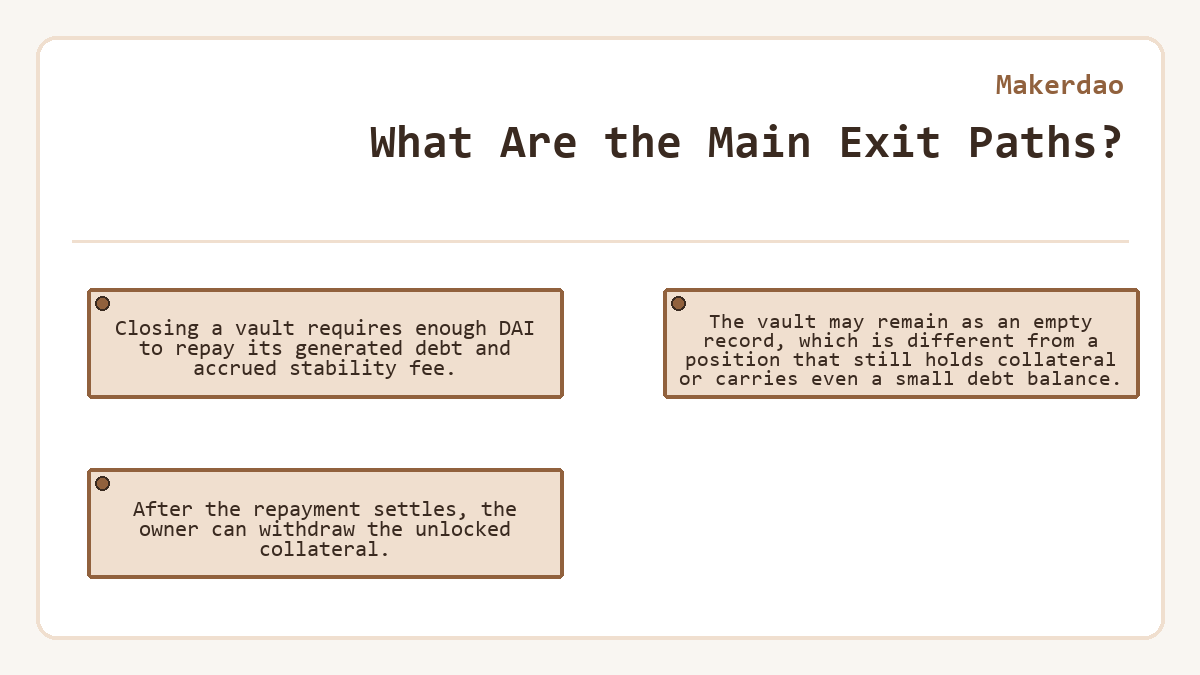
Closing a vault requires enough DAI to repay its generated debt and accrued stability fee. After the repayment settles, the owner can withdraw the unlocked collateral. The vault may remain as an empty record, which is different from a position that still holds collateral or carries even a small debt balance.
The DAI-USDS converter exchanges either token for the other at a fixed 1:1 ratio and assesses no conversion fee, although the network transaction still requires gas. The MKR-SKY route is one-way. Its base conversion is 1 MKR to 24,000 SKY before the applicable Delayed Upgrade Penalty, so the displayed output can be lower than the base amount.
Debt, Balances and Allowances After Exit
Reconciliation starts with the position that actually changed. For a closed vault, the debt should read zero and the expected collateral should appear as withdrawn or claimable. For a token conversion, the input balance should fall and the output balance should rise in the same account after settlement. A transaction receipt alone does not prove that the intended economic state was reached.
DAI supports signed approvals and unlimited allowances, which can remain after a vault action or conversion finishes. An empty vault does not cancel an unrelated token allowance. The owner can inspect the approved spender and amount, then revoke an allowance that is no longer needed without changing the settled vault debt.
Once the records agree, the next decision concerns the recovered asset: keep it idle, deploy it elsewhere or convert it through another supported route.
Makerdao: common questions
Do Maker Vaults Require a Traditional Credit Check?
No. Standard protocol vaults are overcollateralized positions, so the system evaluates posted collateral and its ratio to debt rather than a borrower’s credit history. Opening one requires an Ethereum wallet, an admitted collateral type and enough ETH for network gas. A frontend may still apply regional access terms, and every transaction and vault address remains visible onchain.
When Must Standard Maker Vault Debt Be Repaid?
Standard Maker vault debt has no scheduled maturity date. The position can remain open while it satisfies the active collateral rules and the stability fee continues to accrue through the debt balance. Repayment becomes necessary to release all collateral, while a ratio breach can trigger liquidation before the owner chooses to close. Governance-led collateral offboarding may also change the practical time available for an orderly exit.
Can DAI Still Be Held and Transferred After USDS Launched?
Yes. DAI remains an ERC-20 token that can be held or transferred independently of USDS. The two tokens exist as separate external balances, and the dedicated converter exchanges them in either direction at 1:1 without a conversion fee. Application support can differ, so the receiving contract or venue must support the token actually sent. Converting DAI does not modify a separate vault debt record.
Does USDS Earn the Sky Savings Rate While Sitting in a Wallet?
No. USDS is the base stablecoin and does not accrue the Sky Savings Rate merely by remaining in a wallet. Access to that rate uses the savings module and produces sUSDS as the onchain record of the position. Its exchange value against USDS changes as the rate accrues. This savings position is separate from generating DAI through a collateralized Maker vault.
Is a DAI Balance Proof That the Same Wallet Owns a Vault?
No. DAI is transferable, so a wallet may receive it without creating any vault. The collateral and debt remain attached to the vault record, while the token can move across unrelated accounts and contracts. Sending generated DAI away does not repay the originating debt. Ownership should be established from the vault manager and its recorded owner, not inferred from a current DAI balance.
Why Might a Healthy Vault Fail to Generate More DAI?
A healthy ratio is only one condition for generating more DAI. The collateral type may have reached its debt ceiling, the resulting debt may remain below the configured debt floor or another governance parameter may have changed. A transaction can also remain unconfirmed or fail because the wallet lacks enough ETH for gas. The owner should distinguish a protocol limit from a transaction failure before repeating the action.
Which Token Settles a Maker vault’s Accrued Stability Fee?
DAI settles both principal and the accrued stability fee for a standard Maker vault. USDS is a separate token, even though the converter exchanges DAI and USDS at 1:1. A holder starting with USDS would first need the corresponding DAI balance, then submit the repayment transaction against the correct vault. The converter transaction and the vault repayment are distinct state changes, and each needs its own confirmation.