 Makerdao
 governance separates voting outcomes from the execution of executive proposals.
Makerdao governance separates three states that often look alike in a portal: a recorded vote, a passed proposal and an executed action. To trace a mismatch, first identify the vote type and the address that acted. Then compare the recorded outcome with the proposal status and the target onchain state. A passed poll alone does not prove that protocol parameters changed.
· last updatedThe same title can appear across discussion, polling and executive stages, while each stage answers a different question. Compare the authorized action, the state reached and the evidence left behind.
Missing Vote or Incomplete Action
A missing vote can reflect a display problem, an unrecorded submission or a mismatch between the address checked and the address that voted. Start with the expected evidence. A direct onchain vote should have a successful transaction and a recorded ballot. A relayed voting route is complete only after the relayer submits the vote and the ballot is recorded.
A wallet prompt proves only that the wallet handled a request. It does not prove that the ballot was accepted. Check whether the action targeted the intended poll or executive proposal, whether voting remained open and whether the connected account held or controlled the relevant voting power. Delegated voting also changes which address appears as the active voter.
When the transaction or recorded ballot exists but the portal has not updated, the mismatch may be local to the display or its indexed data. When neither record exists, treat the action as incomplete. Repeating a vote before making that distinction can obscure the original failure without changing the governance outcome.
Poll Outcomes and Executive Execution
A governance poll measures support under the victory conditions written for that poll. Its outcome may approve a document edit, choose among options or authorize work for a later executive proposal. Read the outcome clause before expecting an onchain parameter change. The winning option identifies the decision, but the stated follow-up determines what should happen next.
An executive proposal follows a different path because it contains actions that can alter protocol state. The portal may distinguish active, passed, available for execution, executed and expired states. A passed executive that is waiting for execution has cleared voting but has not completed its technical action. An expired proposal that was never executed can no longer supply that change.
Did a Passed Proposal Change the Protocol?
A passed proposal changed technical state only when the applicable executive action was executed and the intended state transition occurred. The word “passed” identifies a voting result. It does not replace the execution record or the resulting contract state.
First classify the proposal’s intended effect. A poll that approves governance text may be complete when the accepted text is updated. A poll that recommends a risk-parameter change normally needs the later executive action described in its outcome. An executive proposal needs an execution transaction before its smart-contract actions can take effect.
Bundled proposals require action-level checking. One executive may cover several transfers, parameter changes or permissions. Its execution proves that the spell ran, but the proposal title alone does not show whether a particular expected action was included. Match the action description with the specific state that should have changed.
Hypothetical Vote Recovery
This example uses a hypothetical direct-voting address, poll, ballot choice, risk-parameter change and matching executive proposal. The address submits its choice while the poll is open. A successful voting record shows the same address, poll and option, so the voting action itself is complete.
The poll later passes, yet the hypothetical parameter keeps its previous value. That difference is not evidence of a lost vote. The poll outcome says that the selected change will be placed in a later executive proposal, which puts the expected state change beyond the polling stage.
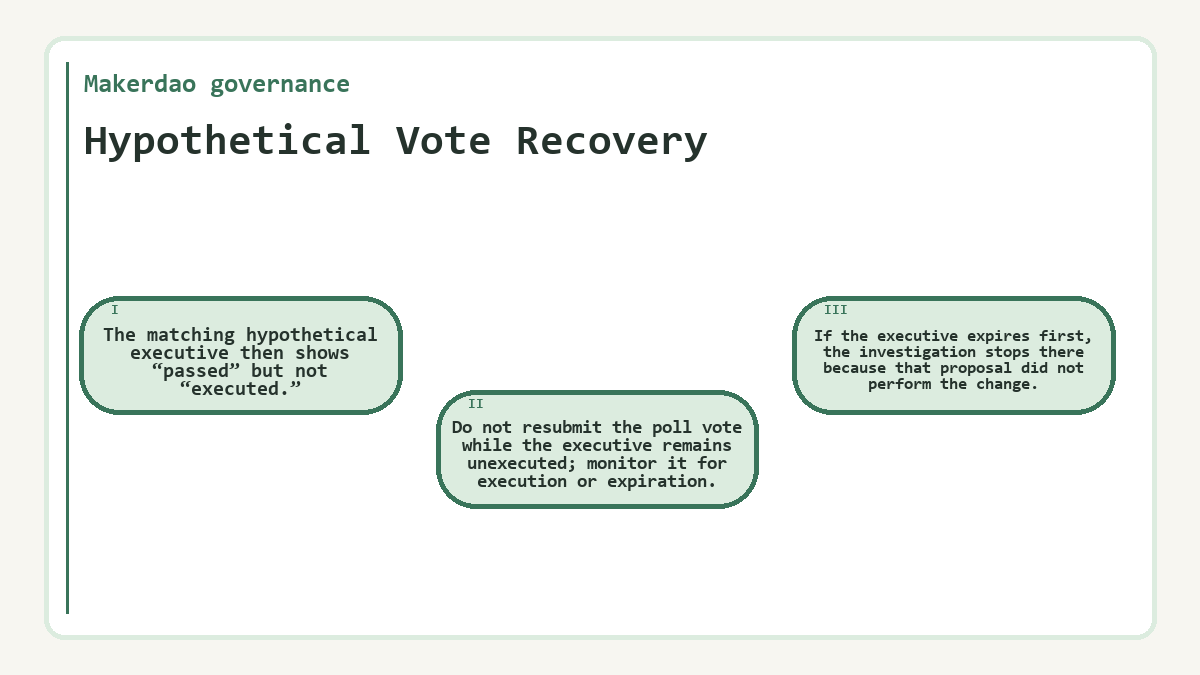
The matching hypothetical executive then shows “passed” but not “executed.” Do not resubmit the poll vote while the executive remains unexecuted; monitor it for execution or expiration. If the executive expires first, the investigation stops there because that proposal did not perform the change.
Once the matching executive shows a successful execution and the target parameter reflects the authorized setting, the check is complete. This confirms that the earlier mismatch came from an unfinished proposal path, not from a missing ballot.
Polls and Executives Compared
Polls and executives differ in purpose, passage evidence, final effect and failure mode. A poll asks voters to express or rank support under its stated voting method. An executive asks voting power to support a package of executable actions. Comparing only titles hides those functional differences.
Voting weight also matters more than the number of participating addresses. Governance outcomes are weighted by eligible token voting power, including power exercised through delegation where applicable. Executive voting uses continuous approval, so a proposal must gain enough support to replace the governing proposal before it can proceed toward execution.
The current portal separates SKY voting from remaining MKR positions in Legacy Governance. This division matters when an older Maker record and a current Sky record appear to describe similar work. Match the voting system, proposal identifier and executable action before treating the entries as one path.
Completion Evidence and Stop Conditions
Completion evidence connects the original decision to its observable effect without relying on one portal label. Use the same proposal identity throughout the check, then stop at the first stage whose required record is missing.
- Confirm the poll or executive identifier, full title and voting window.
- Match the voter or delegate address with the recorded ballot or transaction.
- Read the stated voting method and victory conditions instead of inferring them from a result bar.
- For an executive, distinguish passage, execution availability, successful execution and expiration.
- Compare the executed action with the affected contract state or accepted governance text.
A winning poll that awaits its stated follow-up is an unfinished governance path, not a failed poll. An executed proposal with an unexpected result calls for a narrower comparison of action scope, target contract and chain state. The state transition, rather than a matching headline, shows whether the expected change occurred.
Answers to common questions
-
Why Can a Small Number of Addresses Determine a Governance Result?
- Governance results are weighted by eligible token voting power rather than by giving every address one equal vote. One address may control more voting power than several others, while a delegate may exercise power assigned by multiple holders. The relevant comparison is the voting power supporting each option under the proposal’s stated victory rule, not the raw wallet count.
-
Can One Executive Proposal Combine Actions From Several Earlier Decisions?
- Yes, an executive proposal can bundle multiple authorized actions into one spell. Its title or summary may therefore mention several parameter changes, transfers or permissions. To trace one expected outcome, match that outcome with the detailed action list and then check the proposal’s execution status. Passage of the bundle does not prove execution, and a similar title does not prove inclusion.
-
When Is a Passed Executive Still Incomplete?
- A passed executive remains incomplete for a technical change while it is waiting to become executable or has not yet been executed. If it expires without execution, that proposal does not apply its actions. If execution succeeds before expiration, later expiry does not reverse the completed change; changing it again requires another authorized action.
-
Which Evidence Resolves Conflicting Current and Legacy Governance Statuses?
- Match the proposal identifier, governance system and voting token before comparing the status labels. Current Sky Governance and Legacy Governance can display different records because they represent different voting contexts. For a technical action, the decisive evidence is the matching executive’s execution record and the resulting target state, not whichever interface shows the newer timestamp.